




In a wide-ranging Binance Live AMA, AetheriumX leaders discussed why stable settlement assets, transparent yield and AI-assisted execution could define the next phase of decentralized finance.
The next DeFi cycle may not begin with another wave of governance tokens or increasingly aggressive liquidity incentives. It may begin with something far less dramatic, but potentially more consequential: dollars moving on-chain.
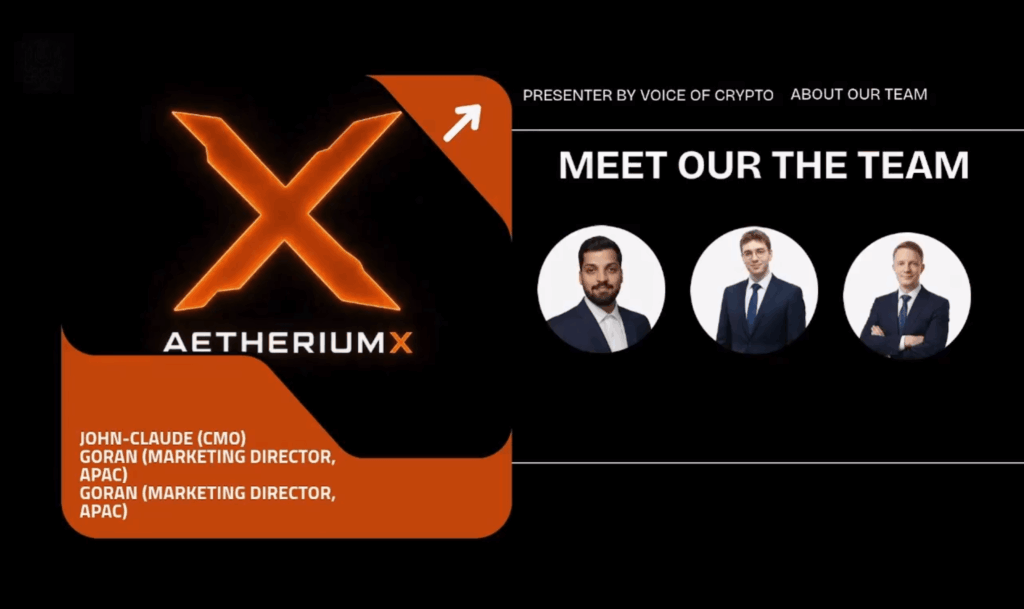
That was the central theme of a recent Binance Live AMA featuring Jean, Chief Marketing Officer of AetheriumX; Mike, Head of Americas and AI Initiative; and Goran Miladinovic, APAC Marketing Director.
The discussion, titled “Onchain Dollars, RWA, and the Next DeFi Cycle,” examined how stablecoins, yield-bearing dollar products and tokenized real-world assets are changing the structure of decentralized finance.
Rather than treating RWA as an uncomplicated growth narrative, the speakers considered both sides of the shift. Real-world assets may introduce more durable sources of yield and attract institutional capital, but they also bring custody dependencies, legal restrictions, redemption risks and questions about whether DeFi can remain genuinely open.
For AetheriumX, the discussion was closely connected to a broader question: how can on-chain finance become more useful and sustainable without losing the transparency, programmability and user control that made DeFi distinctive in the first place?
From Token Incentives to Financial Infrastructure
Previous DeFi cycles were often driven by token emissions, liquidity mining and the expectation of rapid price appreciation. These mechanisms helped protocols attract users and capital, but the activity was not always durable.
When rewards declined or token prices fell, liquidity frequently moved elsewhere.
Jean argued that the growing role of onchain dollars reflects a more mature phase of the market. Stablecoins are no longer used only as temporary parking assets between trades. They increasingly serve as units of account, collateral, settlement assets and gateways into yield strategies.
“The onchain dollar has become the common language of DeFi,” Jean said during the discussion.
That observation points to an important change in user behaviour. Participants may still trade volatile assets, but they typically measure returns, liabilities and portfolio risk in dollar terms. Lending markets are largely built around dollar-denominated borrowing. Protocols settle transactions in stable assets, while users compare yield opportunities through a common dollar reference.
In this context, onchain dollars are becoming infrastructure rather than a secondary product category.
For developers, the shift changes the design priorities of DeFi applications. Products can no longer rely exclusively on temporary incentives. They must demonstrate where yield originates, how collateral is managed, whether liquidity can withstand stress and how the system behaves when market conditions change.
The result may be a less theatrical version of DeFi, but also a more durable one.
Not Every Onchain Dollar Carries the Same Risk
The term “onchain dollar” covers a growing and increasingly diverse group of assets.
Traditional fiat-backed stablecoins sit alongside decentralized stablecoins, synthetic dollar products, yield-bearing tokens and institution-linked instruments backed by government securities or money-market assets.
Although these products may all trade near the same dollar value, their underlying structures can be very different.
The risks associated with a fiat-backed stablecoin are not the same as those of an overcollateralized decentralized asset. A synthetic dollar may depend on derivatives, hedging mechanisms or exchange liquidity. A tokenized Treasury product may introduce an issuer, regulated custodian, transfer restrictions and specific redemption procedures.
This means that the expansion of onchain dollars does not automatically make DeFi simpler or safer. In many cases, it makes the market more complex.
Users must understand not only the advertised yield, but also the legal, technical and operational structure behind it. They need to know who holds the underlying assets, how redemptions work, what happens during periods of illiquidity and whether access can be restricted by geography or regulatory status.
That distinction is likely to become more important as new forms of dollar exposure enter the market.
RWA Brings Real Yield—and a Different Risk Stack
Real-world assets are often presented as the next major source of sustainable on-chain yield.
The reasoning is straightforward. Earlier DeFi models frequently generated returns through token emissions, leverage or activity circulating within the crypto economy. RWA-linked products can connect on-chain capital with external sources of income, including government securities, credit markets and other forms of real-world financial activity.
This can make DeFi less circular.
It can also make the sector more relevant to institutions and users who want exposure to familiar asset classes through blockchain-based infrastructure.
Mike, however, stressed that the presence of a real-world asset does not make a product risk-free.
“RWA does not remove risk. It changes the risk profile,” he said.
Smart contract and token-market risks may be joined by issuer risk, custody risk, redemption risk, jurisdictional exposure and legal enforceability. A product can be backed by a high-quality real-world asset and still face problems if its ownership structure is unclear, its liquidity is limited or its redemption channel fails under pressure.
Transparency therefore becomes more important, not less.
Users should be able to understand where returns come from, which entities control the underlying assets and how on-chain claims connect to off-chain ownership. Without that visibility, tokenization can make an asset easier to access while leaving its most important risks hidden behind the interface.
Does RWA Make DeFi More Serious—or Less Open?
One of the most important parts of the AMA focused on a tension that is often overlooked in optimistic discussions about institutional adoption.
RWA can make DeFi more credible. It can introduce recognizable asset classes, deeper capital pools and yield sources linked to economic activity beyond the crypto market.
At the same time, it can make DeFi less permissionless.
Many real-world financial products operate within legal and jurisdictional boundaries. They may require identity verification, restrict transfers, exclude certain countries or depend on centralized issuers and custodians.
In those cases, a product may use blockchain rails while retaining many of the access rules and institutional dependencies of traditional finance.
Goran suggested that the market is likely to develop into multiple layers rather than converge around a single model.
One layer may be more institutionally oriented, compliance-heavy and closely connected to regulated assets. Another may remain open, crypto-native and experimental. The strongest ecosystems will not pretend that these layers are identical. Instead, they will create useful connections between them while explaining their differences honestly.
That balance matters.
If DeFi becomes only a blockchain-based distribution channel for conventional financial products, it risks losing much of the openness and composability that made the sector innovative. But if it refuses any connection with real-world finance, it may struggle to develop deeper liquidity, more durable yield and broader economic relevance.
The challenge is not choosing one side. It is preserving the strongest properties of DeFi while selectively connecting them to real-world value.
AI Should Explain Risk, Not Hide It
As the number of stablecoins, RWA instruments and structured yield products grows, users face a practical problem: the market is becoming too complex to monitor manually.
Comparing headline yields is relatively easy. Comparing the mechanisms beneath those yields is not.
A user may need to evaluate collateral quality, liquidity depth, smart contract exposure, issuer structure, redemption terms and market conditions before making a decision. These factors can change over time, often across several protocols and networks.
Mike argued that this is where AI could play a useful role.
AI-assisted systems can help users organize information, compare yield sources, identify changes in liquidity and explain how different products are structured. They may also support portfolio monitoring, dynamic allocation and risk alerts.
However, AI should not become another opaque layer between users and their assets.
An interface that simply recommends a product without explaining its assumptions does not solve DeFi’s transparency problem. It only replaces one black box with another.
For AetheriumX, AI-native DeFi is therefore not about removing users from the decision-making process. It is about giving them better tools to understand increasingly complex on-chain environments and, where authorized, supporting execution within clearly defined boundaries.
Where AetheriumX Fits
AetheriumX is developing its ecosystem around the Distributed Capital Intelligence Protocol, or DCIP.
Its broader objective is to coordinate non-custodial on-chain assets with programmable execution and intelligence layers. Within this framework, AI Agents are intended to support capital allocation, strategy comparison, dynamic rebalancing and risk management while operating within user-authorized parameters and maintaining verifiable execution records.
Onchain dollars are important to this model because they provide a comparatively stable unit for settlement, collateral and performance measurement.
AetheriumX’s multi-asset infrastructure is designed to connect on-chain yield opportunities with an ecosystem that also includes GameFi participation, AXT utility, VEXA governance and value capture, and PredictX.
PredictX adds another dimension to the architecture.
Prediction markets convert expectations about real-world events into observable market prices. As macroeconomic developments, policy decisions, asset prices and geopolitical events increasingly affect DeFi, those probability signals may become useful inputs for both users and future intelligence systems.
Within the AetheriumX framework, PredictX is positioned as an event intelligence layer: a market environment in which participants express conviction through capital and outcomes are resolved through auditable processes.
Future RWA-related development would expand the range of assets and yield sources available within this broader structure. The goal is not to present RWA as a replacement for crypto-native finance, but to treat it as one component of a more connected on-chain financial system.
Building for a More Demanding Market
The AMA also reflected a wider change in the Web3 audience.
Users are asking more difficult questions than they did during earlier market cycles. They want to know whether yield is sustainable, how assets are controlled, what risks sit behind a product and whether a protocol can continue operating during periods of market stress.
This creates a higher standard for builders.
Strong branding may attract attention, but it cannot replace transparent product design. High returns may generate short-term participation, but they do not establish long-term trust. As DeFi becomes connected to more sophisticated asset structures, communication must become more precise.
Projects will need to distinguish clearly between products that are operational, features that are being tested and longer-term development plans. They will also need to explain risk in language that ordinary users can understand.
For AetheriumX, that means developing the infrastructure and the communication layer together.
A capital-intelligence system is only useful when users can understand what it is doing, why it is doing it and what risks remain.
The Next DeFi Cycle Will Be Layered
The discussion did not produce a simple prediction for the next cycle. Instead, it pointed toward a more layered financial environment.
Open, crypto-native protocols will continue to experiment. Stablecoins will remain central to trading, lending and settlement. RWA products will connect new forms of yield and institutional capital to blockchain networks. Prediction markets will turn collective expectations into financial signals. AI-assisted systems will help users interpret information and manage increasingly complex decisions.
These elements will not always fit together neatly.
There will be trade-offs between openness and compliance, automation and control, accessibility and legal certainty. The projects that navigate those tensions successfully will be the ones that explain them honestly rather than hiding them behind simplified narratives.
The next phase of DeFi may be more serious, but it should not become less transparent.
For AetheriumX, the direction is clear: build an intelligent, verifiable and user-centered capital layer that connects onchain dollars, real yield, prediction markets and broader ecosystem participation without losing sight of the principles that made decentralized finance valuable in the first place.
The future of DeFi will not be defined by a single token, product or narrative. It will be shaped by how effectively these different financial layers can work together—and whether users can still see, understand and control what happens to their capital.